Short answer
For HVAC maintenance in Knoxville, TN, ENERGY STAR recommends a cooling check in spring and a heating check in fall, plus a filter check every month. A proper tune-up covers thermostat settings, electrical connections, lubrication, the condensate drain and refrigerant level. Seal leaky ducts with mastic, never duct tape, and get any service plan in writing.
When should I schedule HVAC maintenance in Knoxville?
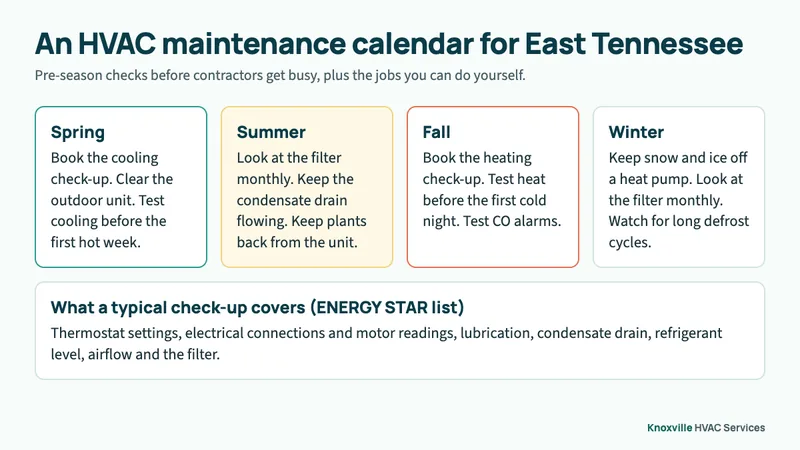
ENERGY STAR recommends checking the cooling system in spring and the heating system in fall. In Knoxville that means a cooling check in March or April, before the first hot spell, and a heating check in September or October, before the first cold snap. ENERGY STAR notes that contractors get busy once summer and winter arrive.
Knoxville averages 36 days a year at 90 F or hotter, and July's daily average is 78.4 F. That is a long cooling season, and a weak part is far more likely to fail in July than in April. Booking early also gives you time to compare a second opinion if the check turns up a bigger problem.
If you have a heat pump, it does both jobs, so it benefits from both visits. A gas furnace with a separate AC needs one heating check and one cooling check.
What does an AC tune-up include?
ENERGY STAR's checklist for a cooling check-up covers thermostat settings, tightening electrical connections and measuring voltage and current on motors, lubricating moving parts, inspecting the condensate drain, and checking the refrigerant level. Many contractors also clean the outdoor coil and check airflow. Ask for a written list of what the visit covers.
The refrigerant check matters. ENERGY STAR says too much or too little refrigerant makes the system less efficient, raises energy costs and shortens the life of the equipment. Low refrigerant usually points to a leak, so ask whether the technician found one rather than accepting a top-off without an explanation.
The condensate drain matters too in a humid climate. A clogged drain can back up and overflow the pan, and some systems shut off when a float switch trips. Our AC repair guide covers what to do if the system stops cooling between visits.
What does a furnace tune-up include?
A heating check-up follows the same ENERGY STAR basics: thermostat settings, electrical connections, motor voltage and current, lubrication, and the condensate drain on high-efficiency furnaces. On a gas furnace, also ask whether the visit checks the gas connections, burners and heat exchanger, since problems there can be a safety issue.
The heat exchanger check is the one to ask about by name. A cracked heat exchanger can let combustion gases into the air stream. If a technician says yours is cracked, ask to see it or a photo, and get the finding in writing before you agree to a replacement.
Make sure your home has working carbon monoxide alarms, especially with gas heat. If an alarm sounds or you smell gas, leave the house and call for help from outside. Our heating repair guide covers the stop-and-get-help signs.
How often should I change my HVAC filter?
ENERGY STAR advises inspecting, cleaning or changing the air filter in your central air conditioner, furnace or heat pump once a month, especially during heavy use in summer and winter. A dirty filter slows airflow, can raise energy costs, and can damage equipment and lead to early failure.
Homes with pets, smokers, ongoing remodeling or a lot of pollen may need a new filter more often. Hold the old one up to a light. If you cannot see light through it, it is due.
- Write the filter size on the return grille or the air handler so you buy the right one.
- Note the airflow arrow on the frame and point it toward the blower.
- Set a phone reminder for the first of each month.
Why does airflow matter so much?
ENERGY STAR says airflow problems can reduce a system's efficiency by up to 15 percent. Blocked returns, closed supply vents, dirty filters, dirty coils and crushed flex duct all cut airflow. Weak airflow also makes coils freeze in summer and makes a furnace run hot in winter, both of which wear parts out faster.
Some airflow fixes are free. Keep furniture and rugs off supply vents and return grilles. Do not close vents in unused rooms, since that can raise pressure in the ducts. Keep the area around the outdoor unit clear of leaves, grass clippings and plants.
A technician can measure airflow and static pressure, which ENERGY STAR lists as something a good contractor does. Ask whether that is part of the tune-up or an extra.
Should I have my ducts sealed?
If your ducts run through an attic, crawlspace or garage, a duct check is worth asking for. ENERGY STAR says that in a typical house about 20 to 30 percent of the air moving through the ducts is lost to leaks, holes and poor connections. That is heated or cooled air you paid for, released somewhere you do not live.
ENERGY STAR lists the signs: high summer and winter bills, rooms that are hard to heat or cool, stuffy rooms, and tangled or kinked flex duct. Leaky ducts can also pull dust and air from attics and crawl spaces into the house.
The fix is mastic sealant or metal tape on the joints and seams. ENERGY STAR is direct about one thing: never use duct tape, as it is not long-lasting. Insulating ducts in unconditioned spaces helps too.
Does a smart thermostat save money?
ENERGY STAR estimates that ENERGY STAR smart thermostats save about 8 percent of heating and cooling bills, or about $50 a year. They do it by adjusting temperatures when you are asleep or away, and by learning your schedule. The savings depend on how you set it up and whether you already adjust your thermostat by hand.
A smart thermostat is a reasonable add-on during a maintenance visit, but check compatibility first. Heat pumps need a thermostat that handles auxiliary and emergency heat correctly, and some older systems have no common wire to power the thermostat. Ask the technician to confirm the wiring before you buy one.
A thermostat in direct sun, over a lamp or near a supply vent will read wrong. If yours is in a bad spot, mention it during the tune-up.
What should an HVAC maintenance agreement spell out?
A maintenance agreement, sometimes called a service plan, is a promise of scheduled visits for a set fee. Before signing one, get the details in writing: how many visits a year, what each visit checks, whether filters or refrigerant are included, and what discount or priority, if any, applies to repairs. Vague plans are hard to hold anyone to.
Questions worth asking:
- Which systems does it cover: AC, furnace, heat pump, or all of them?
- Does the visit include the ENERGY STAR checklist items, such as refrigerant level and electrical connections?
- Does the plan renew automatically, and how do you cancel?
- Can it be transferred if you sell the house?
- Does skipping a visit affect the equipment warranty?
Compare a plan's yearly fee with the cost of booking two single tune-ups. Sometimes the plan is better value. Sometimes it is not.
What maintenance can I do myself, and what needs a pro?
You can safely handle the filter, the clearance around the outdoor unit, vent and return checks, thermostat batteries, and flushing an accessible condensate drain line with water. Leave refrigerant, electrical parts, gas connections and burners to a technician. EPA rules require Section 608 certification for anyone who handles refrigerant.
| Task | Do it yourself | Leave it to a pro |
|---|---|---|
| Check and change the air filter | Monthly, as ENERGY STAR advises | Only if the filter slot is hard to reach |
| Clear leaves and debris from the outdoor unit | Yes, with the power off | Deep coil cleaning |
| Keep supply vents and returns open | Yes | Airflow and static pressure tests |
| Thermostat batteries and settings | Yes | Wiring a new thermostat on a heat pump |
| Condensate drain line | Flush an accessible line with water | Clearing a stubborn clog, float switch issues |
| Refrigerant level | Never | Always, by a Section 608 technician |
| Electrical connections and capacitors | Never | Always |
| Gas pressure, burners, heat exchanger | Never | Always |
How do I find someone for an HVAC tune-up?
Look for a contractor who will list the checklist items in writing, quote the visit price up front, and hold a license you can check with the Tennessee Board for Licensing Contractors' free Verify a License tool. Be wary of a tune-up that turns into a hard push for new equipment.
When you call the number on this site, you are connected with an independent HVAC contractor who takes calls for your area. You are never obliged to hire them. See how referrals work. If a check-up turns up a big repair on an older system, our repair or replace guide can help you decide, and our heat pump guide covers year-round systems.
Sources: ENERGY STAR maintenance checklist, ENERGY STAR duct sealing, ENERGY STAR smart thermostat FAQ, ENERGY STAR hiring tips, EPA Section 608, Tennessee Board for Licensing Contractors, Knoxville climate normals via Wikipedia.