Short answer
For commercial HVAC services in Knoxville, TN, know your equipment type (rooftop unit or split system), have nameplate details and roof access ready, and set a written preventive maintenance schedule. Check the contractor's Tennessee license, call references from similar businesses, and confirm after-hours availability, since it varies by contractor. Your lease decides who pays.
What kinds of commercial HVAC systems are common in Knoxville?
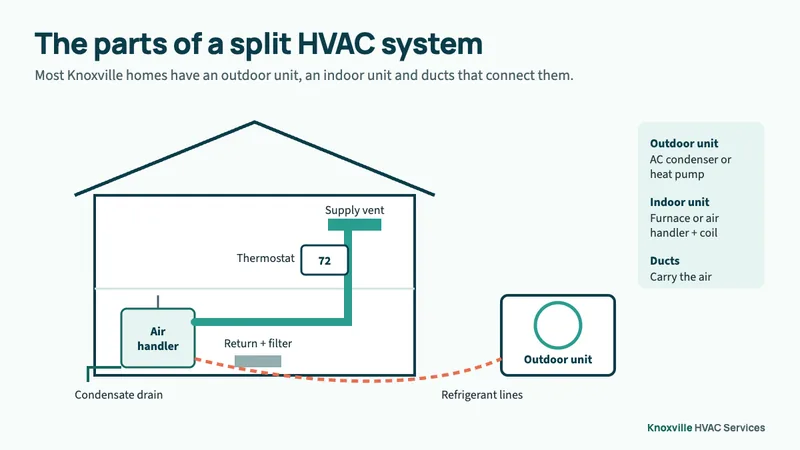
Most small and mid-size businesses run on rooftop units or split systems. Rooftop units, often called RTUs, are packaged systems that hold everything in one cabinet on the roof. Split systems have an outdoor condensing unit and an indoor air handler or furnace, much like a house, and are common in smaller offices, shops and rental buildings.
Larger buildings may use chillers, boilers or variable refrigerant flow systems, which need contractors who work on that equipment regularly. Many Knoxville strip centers, restaurants and office parks use several RTUs, one per tenant space or zone, so a single building may have equipment of different ages and brands on the same roof.
Knowing which type you have is the first thing a commercial HVAC contractor will ask. Look for the nameplate on each unit. It lists the manufacturer, model and serial number, which tells a technician a lot before they climb the ladder.
How are rooftop units different to service?
Rooftop units put the compressor, coils, blower and often gas heat in one weatherproof cabinet, so most service happens on the roof. That means the contractor needs safe roof access, and the technician works in the weather. Belts, filters, economizers and condensate drains are frequent service items on RTUs.
Many RTUs have an economizer, a damper that brings in outside air for free cooling when conditions allow. A stuck economizer can let in hot, humid air in summer or cold air in winter and quietly drive up energy use. Ask whether the preventive maintenance visit checks it.
Roof penetrations and curbs under RTUs are also a common source of leaks. If water appears near a unit after rain, mention it when you call, since it may be a roofing issue, a drain problem or both.
Which businesses use split systems?
Split systems are common in small offices, retail shops, salons, medical suites, churches, daycare spaces and rental properties such as duplexes and small apartment buildings. They work like residential systems, so homeowner basics apply: monthly filter checks, a clear outdoor unit, and seasonal check-ups. The difference is how many people depend on them during business hours.
Restaurants are a special case. Kitchen hoods pull large volumes of air out of the building, and that air has to be replaced, so kitchens often have make-up air units alongside the comfort cooling. If the dining room never cools on busy nights, ask the contractor to look at how the hood, make-up air and HVAC interact.
Ductless mini-splits are also common in server closets, small additions and spaces the main system does not reach. Our heat pump guide covers how mini-splits work.
How often should a business schedule HVAC maintenance?
At minimum, follow the same seasonal pattern ENERGY STAR recommends for homes: check cooling in spring and heating in fall. Commercial equipment often runs longer hours and pulls in more dirt, so many businesses add filter changes between those visits. The right frequency depends on the equipment, the hours it runs and how dusty the space is.
ENERGY STAR's check-up items apply to commercial units too: thermostat and control settings, electrical connections and motor current, lubrication, condensate drains and refrigerant level. It also notes that airflow problems can cut efficiency by up to 15 percent, and that clogged filters can damage equipment.
| Business type | Why it needs attention | Items to ask about |
|---|---|---|
| Restaurant | Grease, heat and make-up air load | Filters, coils, make-up air balance, drains |
| Office or medical suite | Long occupied hours, comfort complaints | Thermostats, zoning, airflow, filters |
| Retail or warehouse | Door openings, dust, large open space | RTU belts, economizers, filters |
| Rental property | Tenants rarely change filters | Filter schedule, drains, written service records |
Keep a simple log for each unit: dates, what was checked, and what was found. It helps the next technician and supports warranty claims.
Can I get commercial HVAC service after hours?
Some contractors offer after-hours or weekend service for businesses, and some do not. Availability varies by contractor and by how busy they are, so never assume. When you call, ask directly whether they can come outside business hours and whether after-hours rates are different. Get the answer before the technician is dispatched.
Many businesses prefer non-urgent work after closing so customers are not disturbed. If that matters to you, say so when you book and ask whether scheduling outside business hours is possible for planned maintenance.
For a true emergency, such as no cooling in a server room or no heat in a building with vulnerable occupants, say so up front. Our emergency HVAC repair page covers what to do while you wait. Whether a contractor can come that night depends on the contractor.
What should I have ready when I call about a commercial HVAC problem?
Have the address, the unit's location and the nameplate details ready, plus a short description of the problem and when it started. Tell the contractor how they will reach the equipment, especially if it is on the roof. A clear first call saves a second trip and helps the technician bring the right parts.
- Equipment details. Manufacturer, model and serial number from each unit's nameplate. A phone photo works.
- Which unit. On a roof with several RTUs, which one serves the problem area. Labels help.
- Symptoms. No cooling, no heat, noise, water, error codes on the thermostat.
- Access. Roof hatch or ladder location, keys, alarm codes, and who will meet the technician.
- Hours. When the space is open and when work can happen without disturbing customers.
- Records. The date of the last service and any recent repairs.
- Authority. Who can approve repairs, and any spending limit set by the owner or manager.
How do I choose a commercial HVAC contractor?
Choose a contractor who works on your type of equipment, holds a license you can check, provides references from similar businesses, and puts the scope of work and price in writing. In Tennessee, the Board for Licensing Contractors regulates contractors, and its free Verify a License tool lets you search by name.
ENERGY STAR's hiring advice applies to commercial work too: find out your state's license and insurance requirements, call references, and get written, itemized estimates before work begins.
- Ask whether they regularly service RTUs, split systems or the specific equipment you have.
- Ask for references from businesses like yours, and call at least one.
- Ask for proof of insurance and confirm it covers roof work.
- Get a written scope for maintenance: units covered, visit frequency, what each visit checks.
- Ask how they report findings, such as a written summary or photos after each visit.
Who pays for HVAC repairs in a leased commercial space?
It depends on the lease. Some commercial leases make the tenant responsible for HVAC maintenance and repairs, some keep it with the landlord, and many split it, for example tenant handles routine maintenance and landlord handles replacement. Read the HVAC, maintenance and repair clauses before you call anyone, and talk to the other party early.
This is general information, not legal advice. If the lease is unclear, ask your attorney or property manager before approving a major repair. A few practical steps help either way:
- Tell the landlord or property manager in writing when the system fails.
- Ask whether they have a preferred contractor or a service agreement already in place.
- Keep copies of invoices and maintenance records, since some leases require proof of regular service.
- Agree in writing who approves and pays before replacement work starts.
When should a business replace an old rooftop unit?
ENERGY STAR suggests talking to a contractor about replacement when an air conditioner or heat pump is more than 10 years old, and that guidance is a reasonable starting point for small commercial units too. Repeated repairs, rising energy bills, comfort complaints and old R-22 refrigerant are other reasons to get replacement quotes.
The EPA notes that most HCFCs, including HCFC-22, have been phased out, with some use continuing only to service existing equipment. A leak on an R-22 unit can make repair hard to justify. ENERGY STAR also warns that oversized equipment cycles too often, so ask for a load calculation rather than a same-size swap. Our replacement guide covers how to compare quotes.
When you call the number on this site, you are connected with an independent HVAC contractor who takes calls for your area, including commercial work where they offer it. You are never obliged to hire them. See how referrals work, and our maintenance guide for the check-up basics.
Sources: ENERGY STAR maintenance checklist, ENERGY STAR hiring tips, ENERGY STAR replacement guide, ENERGY STAR quality installation, EPA HCFC phaseout, Tennessee Board for Licensing Contractors.