Short answer
For heat pump repair in Knoxville, TN, first tell normal defrost (brief steam, then a clear coil) from a fault (thick ice that stays, cool air in heat mode, aux heat all day). Check the thermostat, breakers and filter. For heat pump installation, insist on a load calculation, a duct check and written, itemized quotes.
How does a heat pump heat and cool a house?
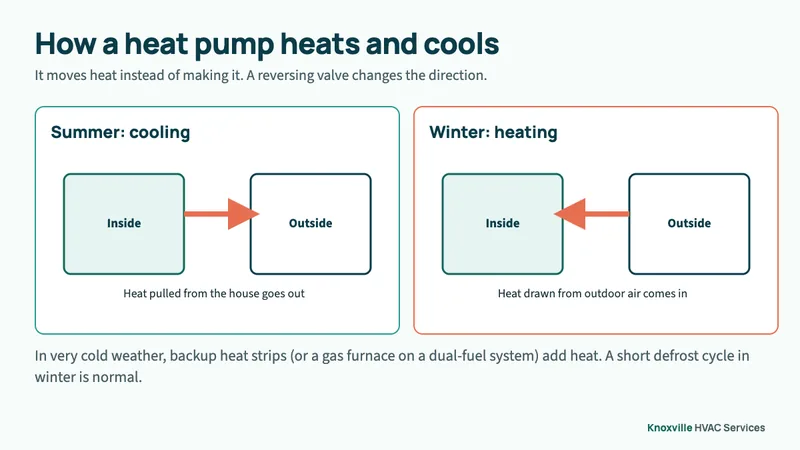
A heat pump moves heat instead of making it. In summer it pulls heat out of your house and dumps it outside, like a central air conditioner. In winter a reversing valve flips the flow, and it pulls heat from the outdoor air and brings it inside. One outdoor unit does both jobs.
Because it moves heat rather than burning fuel, it uses less energy. ENERGY STAR says an air-source heat pump can deliver up to three times more heat energy to a home than the electrical energy it consumes. The Department of Energy adds that modern air-source heat pumps can cut electricity use by 50 percent compared to furnaces and baseboard heaters.
They are common. The DOE reports that, as of 2020, over 17 million housing units had heat pumps installed. In East Tennessee, with mild winters and long, humid summers, they are a natural fit.
Why is steam coming off my heat pump in winter?
Steam or a cloud of vapor from the outdoor unit in cold weather is usually the defrost cycle, and it is normal. Frost builds on the outdoor coil when it pulls heat from cold, damp air. Every so often the system reverses briefly to warm the coil and melt that frost. It often looks and sounds dramatic.
During defrost you may notice the outdoor fan stop, a whoosh as the valve shifts, water running off the coil, and a short burst of cooler air indoors. Many systems turn on backup heat to cover the gap. A normal defrost ends on its own, and the coil should look mostly clear afterward.
What is not normal is a coil that stays frozen solid, or a defrost that seems to run all the time. That points to a fault, and it is covered in the next section.
Is ice on my heat pump a problem?
A thin layer of frost on the outdoor coil in winter is normal and should clear during defrost. A thick block of ice that encases the coil, the top of the unit, or the fan is a problem. So is ice that never clears. Turn the system to Emergency Heat if it has that setting, and call for service.
Common causes of heavy ice:
- Defrost control or sensor fault. The unit never gets the signal to defrost.
- Outdoor fan not running. Without airflow, the coil keeps getting colder.
- Low refrigerant. ENERGY STAR notes that too much or too little refrigerant lowers efficiency and shortens equipment life.
- Water dripping onto the unit. A broken gutter or downspout above the unit can refreeze on the coil every night.
Do not chip ice off with a tool. The fins and tubes are thin and easy to puncture. You can pour lukewarm water over the coil with the power off, but the cause still needs to be found.
What do aux heat and emergency heat mean on my thermostat?
Aux heat (auxiliary) is backup heat the system turns on by itself, usually electric heat strips or a gas furnace, when the heat pump cannot keep up or is defrosting. Emergency heat is the same backup source, but you switch it on by hand, and the heat pump stays off. Use emergency heat only when the heat pump has failed.
Seeing "Aux" for short periods on a cold morning, or after you raise the thermostat several degrees, is normal. Seeing it all day on a mild day is a sign the heat pump itself is not doing its share. Since backup electric heat costs more to run, it shows up on the power bill.
To keep aux heat from kicking on needlessly, raise the setpoint a degree or two at a time rather than all at once. If your thermostat shows Emergency Heat and you did not set it, switch it back and see whether the heat pump runs. If it does not, that is a service call.
What are the most common heat pump faults?
Most heat pump repair calls involve electrical parts that wear out, a stuck reversing valve, defrost problems, refrigerant leaks, and airflow problems indoors. Because a heat pump runs in both summer and winter, its parts work more hours a year than an air conditioner that sits idle from October to May.
| What you notice | Likely cause | What a technician usually checks |
|---|---|---|
| Blows cool air in heat mode | Reversing valve stuck, low refrigerant, or the unit is in defrost | Valve and solenoid, refrigerant charge, defrost controls |
| Outdoor unit hums but does not start | Failed capacitor or contactor | Tests and replaces the failed electrical part |
| Thick ice that does not clear | Defrost board or sensor, outdoor fan, low charge | Defrost cycle, fan motor, refrigerant pressures |
| Aux heat runs all day in mild weather | Heat pump not carrying the load, thermostat wiring | Thermostat setup, outdoor unit operation |
| Runs constantly, home never reaches setpoint | Dirty filter or coil, duct leaks, low charge, undersized unit | Airflow, coils, ducts, charge |
| Short cycles every few minutes | Oversized equipment, thermostat or control fault | Controls, wiring and equipment sizing |
Before calling, check the thermostat mode, the breakers for both the indoor and outdoor units, and the filter. ENERGY STAR says a dirty filter can raise energy costs and damage equipment. Our heating repair guide covers no-heat checks in more detail.
Should I get a ducted heat pump or a ductless mini-split?
If your home already has ducts in decent shape, a ducted heat pump is usually the simpler choice. ENERGY STAR describes it as a central air conditioner that also runs in reverse, and it can connect to existing forced-air ductwork. A ductless mini-split suits homes without ducts, additions, garages and rooms the main system never reaches.
ENERGY STAR explains that a mini-split has an indoor unit mounted on an interior wall or ceiling, connected to an outdoor unit, and needs no ductwork. One outdoor unit can often serve more than one indoor head.
| Question | Ducted heat pump | Ductless mini-split |
|---|---|---|
| Needs ductwork? | Yes, can reuse existing forced-air ducts | No |
| Best fit | Whole homes with sound ducts | Additions, older homes without ducts, single rooms |
| Room-by-room control | Limited unless zoned | Each indoor head has its own setting |
| Duct losses | Possible if ducts leak | None, since there are no ducts |
Some homes use both: a ducted system for the main floor and a mini-split for a bonus room over the garage. Ask the contractor to explain why they recommend one over the other for your layout.
What is a dual-fuel heat pump system?
A dual-fuel system pairs an electric heat pump with a gas furnace instead of electric heat strips. The heat pump handles cooling and most heating. When it gets cold enough that the furnace makes more sense, the controls switch to gas. It suits homes that already have a gas line and a furnace in working order.
Whether dual fuel pays off depends on your gas and electric rates, the age of your furnace, and how cold your winters get. Knoxville's January daily average is 38.2 F, with an average of 5 days where the high stays at or below freezing, so most heating hours are in heat pump territory.
Ask the contractor at what outdoor temperature the system will switch to gas, and whether you can adjust it. That setting has a big effect on how the system runs.
What size heat pump does my house need?
The right size comes from a load calculation, not the size of the old unit or a rule of thumb per square foot. A proper calculation accounts for insulation, windows, air leaks, the direction the house faces and the ducts. ENERGY STAR warns that oversized equipment may cycle too often, giving less comfort and a shorter lifespan.
Short cycling is a real problem with heat pumps in humid summers. A unit that shuts off too quickly cools the air but does not run long enough to pull out moisture, so the house feels clammy.
ENERGY STAR's quality installation guidance also stresses correct refrigerant charge, which it says helps reduce energy use and lowers the risk of system failure. It suggests asking the contractor to inspect the ducts, run a leakage test and make repairs. ACCA lists accredited contractors through its Quality Assured program, which is one place to start.
Can a heat pump replace my old AC or furnace?
Often, yes. ENERGY STAR says that in most climate zones an air-source heat pump can be installed as a drop-in replacement when either a central air conditioner or a furnace needs replacing. If your AC is failing, swapping it for a heat pump gives you cooling plus efficient electric heat from the same outdoor unit.
ENERGY STAR suggests calling a contractor about replacement once a heat pump or air conditioner is more than 10 years old, or a furnace is more than 15 years old. It says high-efficiency equipment, installed correctly, can save up to 20 percent on heating and cooling costs. Our AC replacement guide covers the repair or replace decision and how to compare quotes.
For heat pump installation, get written, itemized estimates from more than one contractor, as ENERGY STAR advises, and compare efficiency and warranties as well as price.
How do I keep a heat pump running well?
Because a heat pump works year round, it benefits from two check-ups a year: one in spring for cooling and one in fall for heating, as ENERGY STAR recommends. Between visits, check the filter monthly, keep plants and leaves at least a couple of feet from the outdoor unit, and keep gutters from dripping on it.
In winter, clear snow away from the base so the defrost water can drain. In summer, hose off grass clippings from the coil gently, with the power off. Our HVAC maintenance guide lists what a check-up should cover.
When you call the number on this site, you are connected with an independent HVAC contractor who takes calls for your area. You are never obliged to hire them. See how referrals work, and check any contractor's license with the Tennessee Board for Licensing Contractors' free Verify a License tool.
Sources: ENERGY STAR air-source heat pumps, U.S. Department of Energy on heat pumps, ENERGY STAR quality installation, ENERGY STAR replacement guide, ENERGY STAR maintenance checklist, Tennessee Board for Licensing Contractors, Knoxville climate normals via Wikipedia.