Short answer
For heating repair in Knoxville, TN, check the thermostat, breaker, service switch, filter and furnace door first. If the house is still cold, a failed igniter, dirty flame sensor, blower fault or heat pump problem is the usual cause. Leave at once if you smell gas, and get the repair price in writing.
What should I check when my heat stops working?
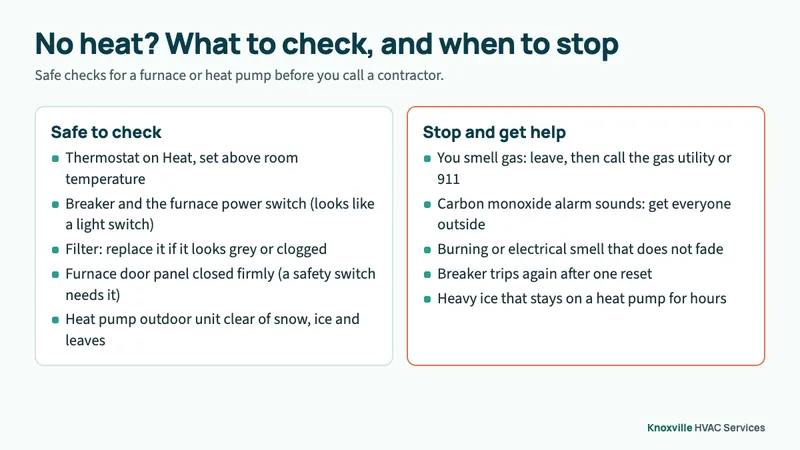
Start with the thermostat: set it to Heat, a few degrees above the room, and replace weak batteries. Then check the furnace or air handler breaker, the switch near the unit that looks like a light switch, the air filter, and the furnace door panel, which must be closed for the system to run.
These checks are safe and take a few minutes. They also rule out the most common reasons a heating repair visit ends with "it was the thermostat".
- Thermostat. Heat mode, setpoint above the room temperature, fan on Auto. A blank screen usually means batteries or a tripped breaker.
- Power. Check the breaker for the furnace or air handler, and the service switch mounted on or near the unit.
- Filter. ENERGY STAR advises inspecting, cleaning or changing filters once a month during heavy use. A clogged filter can make a furnace overheat and shut itself off.
- Door panel. Most furnaces have a safety switch behind the lower door. If the panel is loose, the burner will not light.
Is it a gas furnace, a heat pump or electric heat?
Knowing your system type changes what you check and what you tell the contractor. A gas furnace burns gas and has a flame you may see through a small window. A heat pump has an outdoor unit that runs in winter. Electric strip heat sits inside the air handler and often backs up a heat pump.
Many Knoxville area homes heat with a heat pump, and some pair it with a gas furnace in a dual-fuel setup. If you are not sure, look for a gas line and flue pipe on the indoor unit, and check whether the outdoor unit runs when the heat is on.
| System | How it heats | What to check first |
|---|---|---|
| Gas furnace | Burns natural gas or propane, blower moves the warm air | Thermostat, breaker, service switch, filter, door panel, gas supply valve |
| Heat pump | Moves heat from outdoor air into the house | Thermostat mode, outdoor unit running, ice that does not clear |
| Electric strip heat | Electric coils inside the air handler | Breakers, which are often separate and larger for the heat strips |
If you have a heat pump, see our heat pump repair guide, which covers defrost cycles and emergency heat settings.
Why does my furnace turn on and off every few minutes?
Short cycling means the furnace starts, runs briefly and shuts down, over and over. Common causes are a clogged filter that lets the furnace overheat, a dirty flame sensor, a thermostat in a poor spot, or a system that is too large for the house. It wastes energy and wears parts.
Change the filter first and see whether the cycles get longer. If they do not, a technician should check the safety limits, the flame sensor and the thermostat. Sizing matters too. ENERGY STAR notes that oversized equipment may cycle too frequently, which gives less comfort and a shorter lifespan.
What are the most common furnace repairs?
The parts that fail most often on a gas furnace are the ignition system, the flame sensor, the blower motor and its capacitor, the inducer motor, and safety switches that trip when airflow is poor. A technician tests each one, because several faults look the same from the thermostat: the house simply stays cold.
| What you notice | Common cause | What a technician usually does |
|---|---|---|
| Furnace clicks, tries to light, then stops | Ignition fault or dirty flame sensor | Tests the igniter, cleans or replaces the sensor |
| Blower runs but air is cold | Burner not lighting, gas supply issue | Checks gas pressure, ignition and safety controls |
| No sound at all | Power, door switch, fuse or control board | Traces power through switches and the board |
| Loud squeal or rattle | Blower motor or belt wear, loose panel | Inspects the motor, bearings and mounts |
We do not publish repair prices, because they depend on the part, the furnace and the contractor. Ask for the diagnostic fee up front, and get the repair price in writing before work begins, as ENERGY STAR advises.
How do I stay safe from carbon monoxide with a gas furnace?
Put a carbon monoxide alarm on every level of the house and near sleeping areas, and test them when you change the clocks. If a CO alarm sounds, get everyone outside into fresh air and call for help from there. Do not go back in to look for the cause.
If you smell gas, leave the house straight away. Do not switch lights or appliances on or off, and do not use a phone indoors. Call your gas utility or 911 from outside. Once the house is cleared, a furnace repair contractor can find the fault. A yearly heating check-up in fall is the best way to catch a cracked part or a blocked flue before it becomes a hazard.
Should I repair or replace a furnace that is over 15 years old?
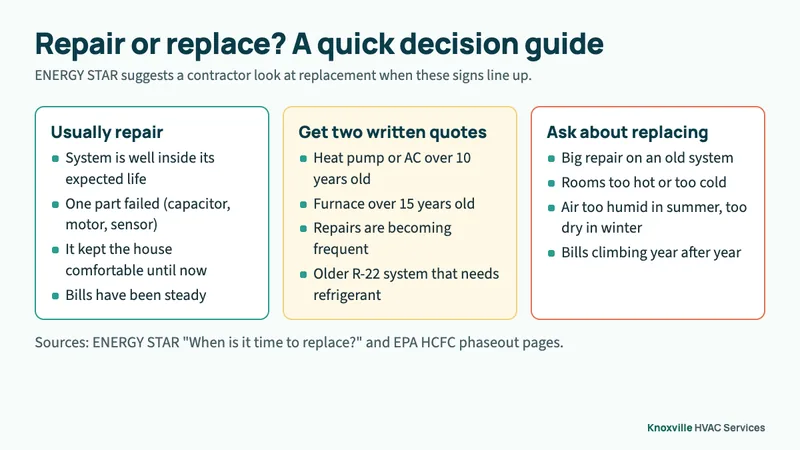
ENERGY STAR suggests calling a contractor to look at replacement when a furnace or boiler is more than 15 years old. Age alone does not decide it. A single failed igniter on a furnace that has run well is usually worth fixing. A cracked heat exchanger or repeated breakdowns on an old unit often are not.
Efficiency is the other half of the decision. ENERGY STAR says an ENERGY STAR furnace is 15% more efficient than a conventional furnace. If you are replacing anyway, it is worth asking whether a heat pump or a dual-fuel system suits the house. Our HVAC replacement guide covers sizing and written quotes.
When is no heat an emergency in Knoxville?
No heat becomes urgent when the house is getting cold enough to put people or pipes at risk. Knoxville averages only 5 days a year where the high stays at or below freezing, but those days do come, and January's daily average is 38.2 F. Infants, older adults and anyone ill are most at risk.
Gas smells, CO alarms and burning smells are always emergencies. For what to do while you wait and what to ask on an after-hours call, see our emergency HVAC repair guide.
How do I choose a heating repair company in Knoxville?
Choose a company that tells you its fees before the visit, holds a Tennessee license you can check, and puts the repair price in writing. The Tennessee Board for Licensing Contractors runs a free Verify a License tool. ENERGY STAR also suggests asking for references and calling them.
- Ask whether they work on gas furnaces, heat pumps or both.
- Ask if a diagnostic fee is credited toward the repair.
- Be wary of pressure to replace on the first visit without a written diagnosis.
When you call the number on this site, you reach an independent HVAC contractor who takes calls for your area. See how referrals work.
How can I avoid a furnace breakdown this winter?
Book a heating check-up in fall, before the first cold snap keeps contractors busy, and change the filter monthly during heavy use. ENERGY STAR recommends checking the heating system in the fall and lists tightening electrical connections, lubricating moving parts and checking controls among the check-up items.
Keep supply vents and the return grille open and clear of furniture. ENERGY STAR notes that airflow problems can cut efficiency by up to 15 percent. Our HVAC maintenance guide has the full seasonal list.
Sources: ENERGY STAR maintenance checklist, ENERGY STAR replacement guide, ENERGY STAR quality installation, ENERGY STAR hiring tips, Tennessee Board for Licensing Contractors, Knoxville climate normals via Wikipedia.