
Short answer
For AC replacement in Knoxville, TN, ENERGY STAR suggests weighing replacement once an AC or heat pump passes 10 years old. Before you buy, ask for a load calculation, a duct inspection and leakage test, and written, itemized quotes. Compare quotes line by line, check the contractor's Tennessee license, and ask who pulls any permit.
When should I replace my air conditioner instead of repairing it?
ENERGY STAR suggests calling a contractor about replacement when a heat pump or air conditioner is more than 10 years old, or a furnace or boiler is more than 15 years old. Age is a prompt, not a verdict. Weigh the repair price, how well the system has worked, and whether more parts are near the end.
ENERGY STAR lists other signs worth a look: rooms that are too hot or too cold, air that is too dry in winter or too humid in summer, and rising energy bills. It notes these can come from equipment problems, duct problems or poor insulation, so a new unit is not always the fix.
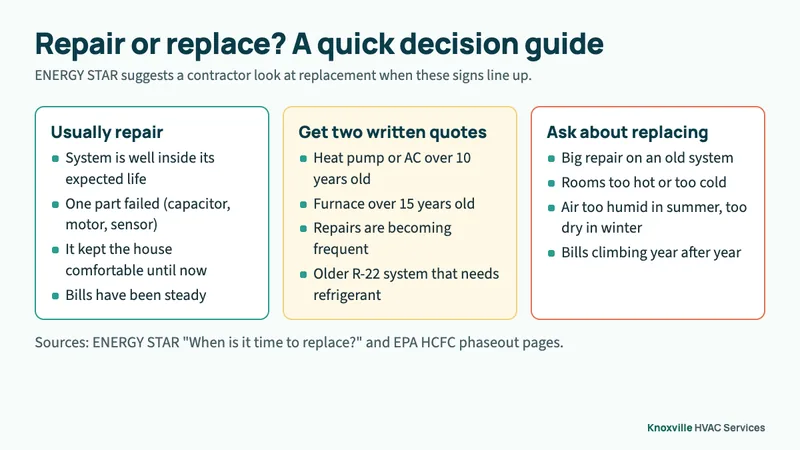
A single failed capacitor on a system that cooled well last summer is usually worth repairing. A failed compressor on an older system that was already struggling usually is not. When you are unsure, get a second written opinion before you decide.
Does an old R-22 system change the decision?
Yes, often. Many older systems use R-22, also called HCFC-22. The EPA notes that most HCFCs have been phased out, with some use continuing only to service existing equipment, and that the full HCFC phaseout comes in 2030. A refrigerant leak on an R-22 system can make the repair hard to justify.
Look at the label on the outdoor unit. It names the refrigerant type. If it says R-22 and the system needs refrigerant, ask the contractor three things: whether they found and can fix the leak, what the refrigerant will cost, and what replacement would cost by comparison. Get both answers in writing.
The EPA also requires technicians who handle refrigerant to hold Section 608 certification, so refrigerant work is never a DIY job.
How much can a new AC or heat pump save?
ENERGY STAR says high-efficiency heating and cooling equipment, installed correctly, can save up to 20 percent on heating and cooling costs. It puts a typical household energy bill at around $1,900 a year, with almost half going to heating and cooling. The words "installed correctly" carry a lot of weight in that claim.
An efficient unit that is oversized, undercharged or connected to leaky ducts will not deliver those savings. That is why the rest of this guide focuses on the installation, not the brand.
If you are replacing a central AC, ask about a heat pump too. ENERGY STAR says that in most climate zones an air-source heat pump can be a drop-in replacement for a central air conditioner or a furnace. Our heat pump guide explains how they work.
What is a load calculation, and why does it matter?
A load calculation works out how much heating and cooling your house actually needs, based on its size, insulation, windows, air leakage, orientation and ductwork. It is how a contractor picks the right size. Matching the old unit's size is a guess, because the old unit may have been wrong, or the house may have changed since.
ENERGY STAR warns that oversized equipment may cycle too frequently, which means less comfort and a shorter lifespan. In a humid Knoxville summer, short cycles also leave the air damp, because the system shuts off before it has removed much moisture.
- Ask whether the quote is based on a load calculation.
- Ask for a copy of it, or at least the result.
- Tell the contractor about any changes since the last install, such as new windows, added insulation or a finished basement.
Should the ducts be checked during AC installation?
Yes. ENERGY STAR says that in a typical house about 20 to 30 percent of the air moving through the duct system is lost to leaks, holes and poorly connected ducts. A new system on leaky ducts wastes part of what you paid for. ENERGY STAR suggests asking the contractor to inspect the ducts, run a leakage test and make repairs.
Signs your ducts need attention, according to ENERGY STAR, include high bills in summer and winter, rooms that are hard to heat and cool, stuffy rooms, ducts in the attic, crawlspace or garage, and tangled or kinked flex duct.
ENERGY STAR also notes that leaky ducts can pull dust and air from attics, crawl spaces and basements into the house. Ducts should be sealed with mastic or metal tape. It is clear on one point: never use duct tape, as it does not last.
What should a written HVAC installation quote include?
ENERGY STAR advises getting written, itemized estimates, comparing cost, energy efficiency and warranties, and signing a written proposal before work starts. An itemized quote lists the equipment by model number, the labor, and every extra part of the job, so you can compare two quotes line by line instead of comparing two totals.
A complete quote for HVAC installation usually names:
- Outdoor and indoor equipment model numbers, and the efficiency ratings.
- Whether the indoor coil or air handler is being replaced or reused.
- New refrigerant line set, or reuse of the existing one.
- Thermostat, pad, electrical disconnect and drain work.
- Duct testing, sealing or changes, if any.
- Removal of the old equipment and refrigerant recovery.
- Equipment warranty and labor warranty, written separately.
- Who handles any permit, and whether it is included.
How do I compare two AC replacement quotes?
Put the quotes side by side and check whether they describe the same job. Two prices that look far apart often cover different work: one may replace the indoor coil and line set while the other reuses them. Ask each contractor to explain any line the other one has and they do not.
| Item to compare | Quote A | Quote B |
|---|---|---|
| Sized from a load calculation? | Yes / No | Yes / No |
| Outdoor and indoor model numbers listed? | Yes / No | Yes / No |
| Indoor coil replaced or reused? | ||
| Line set replaced or reused? | ||
| Duct inspection and leakage test included? | Yes / No | Yes / No |
| Labor warranty length, in writing | ||
| Permit handled by the contractor? | Yes / No | Yes / No |
| License verified with the state? | Yes / No | Yes / No |
Print this table or copy it into a note and fill it in as you talk to each contractor. The lowest total is not the best deal if it skips the duct test or reuses a coil that does not match the new outdoor unit.
What happens on AC installation day?
A typical replacement starts with shutting off power and recovering the old refrigerant, then removing the old outdoor unit and, if it is being replaced, the indoor coil. The crew sets the new equipment, connects the line set, wiring and drain, then pulls a vacuum on the lines before releasing the refrigerant charge.
The last steps matter most. ENERGY STAR notes that correct refrigerant charge helps reduce energy use and lowers the risk of failure. Ask the crew to:
- Check and record the refrigerant charge after start-up.
- Measure airflow, which ENERGY STAR says a good contractor does.
- Show you the new filter size and how to change it.
- Set up the thermostat and explain the settings.
- Leave the warranty registration details and the paperwork.
Ask the contractor ahead of time how long the job is expected to take, and plan for the house to be without cooling during that time.
Do I need a permit to replace an air conditioner in Knoxville?
Many HVAC replacements require a permit, but the rules depend on where you live and the scope of the job. Rather than guess, ask the contractor directly whether a permit is needed for your address and who will pull it. A contractor who suggests skipping a required permit is a warning sign.
Knoxville, Knox County and the surrounding towns each have their own building offices. If the contractor pulls the permit, ask that it be listed on the written quote, and keep a copy of the final inspection with your home records. It can matter when you sell the house.
How do I choose an HVAC installation contractor?
Choose one who will do a load calculation, inspect the ducts, put an itemized quote in writing and hold a license you can check. The Tennessee Board for Licensing Contractors regulates contractors and home improvement contractors, and its free Verify a License tool takes a minute.
ENERGY STAR also suggests finding out the license and insurance requirements for your state and calling references. ACCA lists accredited contractors in its Quality Assured program, which is another way to start a shortlist.
When you call the number on this site, you are connected with an independent HVAC contractor who takes calls for your area. You are never obliged to hire them, and getting a second quote is always fine. See how referrals work. If your system just needs a fix, start with our AC repair guide.
Sources: ENERGY STAR replacement guide, ENERGY STAR quality installation, ENERGY STAR duct sealing, ENERGY STAR hiring tips, ENERGY STAR air-source heat pumps, EPA HCFC phaseout, EPA Section 608, Tennessee Board for Licensing Contractors.